At a glance
- The sidecar appeared at the very start of the twentieth century and was in mass use within a decade. It was not a novelty then; it was the most economical way to move three people.
- Before affordable small cars, an outfit carried a worker, a spouse and a child on one engine and one tax bill. Whole industries were built on that arithmetic.
- The affordable enclosed car and the changing licence rules. Once a small saloon asked no more of a household and kept the rain off, the argument for a chair collapsed.
- Production continued in places where roads, means or winter made the outfit still make sense, which is why restorable machines exist at all today.
The beginning, and who gets the credit
The sidecar arrives with the motorcycle itself. As soon as there were engines light enough to put in a bicycle frame, there were people trying to work out how to bring somebody else along, and the answers of the 1890s were forked frames, trailers and various alarming forward-mounted seats. The recognisable sidecar, a wheeled body on a rigid chassis beside the machine, is a very early twentieth century idea, and it was patented and re-patented in several countries within a few years of each other.
Credit is genuinely contested, which is normal for an invention that several people arrive at simultaneously because the problem is obvious and the materials have just become available. What is not contested is how quickly it spread. Within a decade of the first designs, sidecars were being manufactured in volume rather than improvised in sheds.
The important thing about the date is what it tells you about the purpose. This was not a leisure object. It was invented into a world where the alternative to a motorcycle was a horse or a train, and where a car was an item of extreme wealth.
Why it became the ordinary way to travel
For roughly forty years, an outfit was the sensible answer for a working household that needed to move more than one person. You bought one engine, one set of running expenses and one licence, and you could carry a passenger, a child, a week of shopping or a set of tools. A car with the same capacity was several times as expensive to buy and to run.
The design responded accordingly. Chairs were made for adults and for children, for luggage, for tradesmen's tools, for doctors on call, and for delivery. The variety of bodies produced in this period is much wider than the single touring shape most people picture, and it includes some genuinely strange commercial designs.
The military did a great deal of the same reasoning at scale. Outfits went to war repeatedly across the first half of the century because they could carry weight, cross poor ground, and be repaired by anybody with a spanner. Much of the engineering that makes a good sidecar chassis was refined under exactly those conditions.
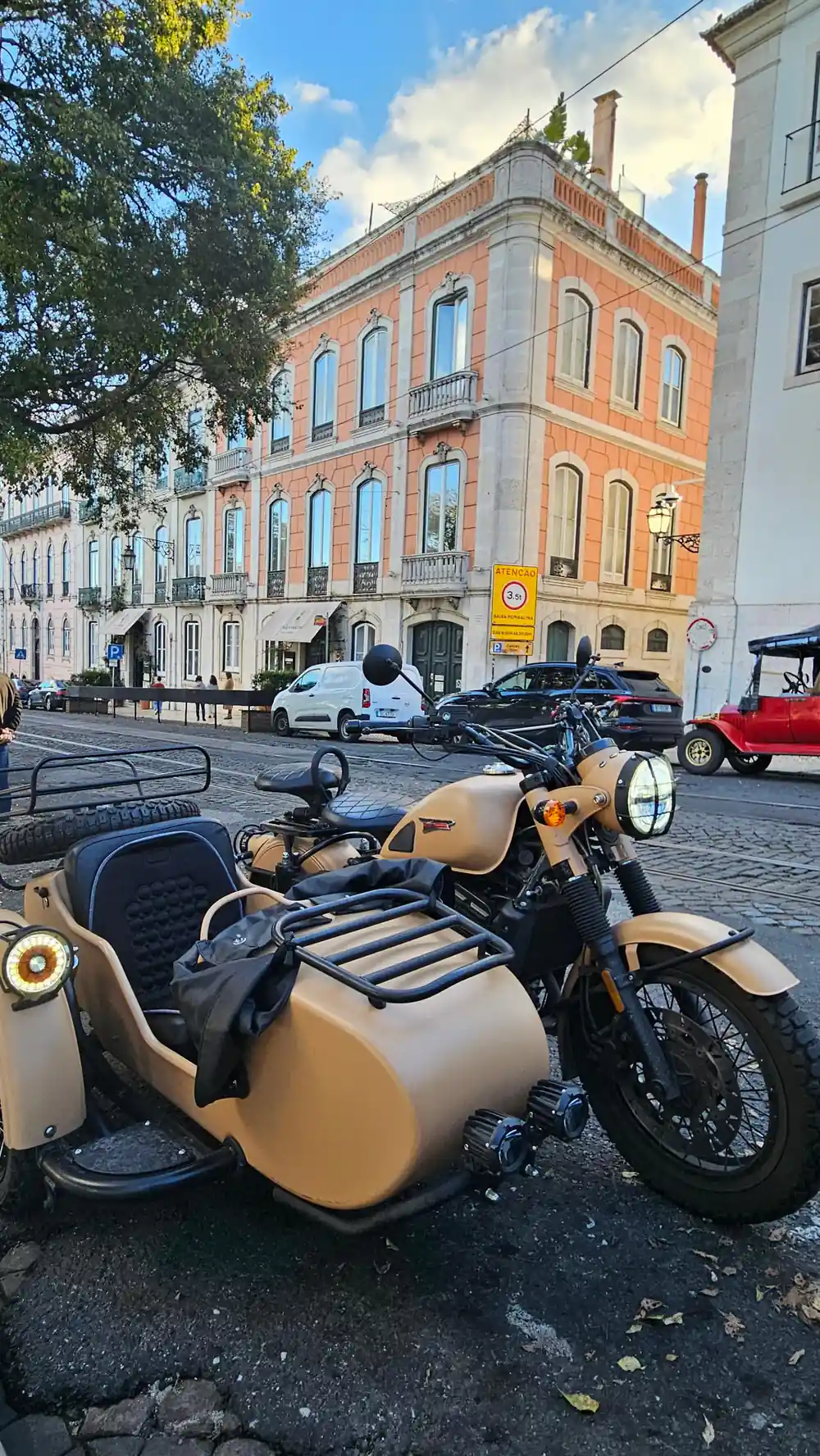
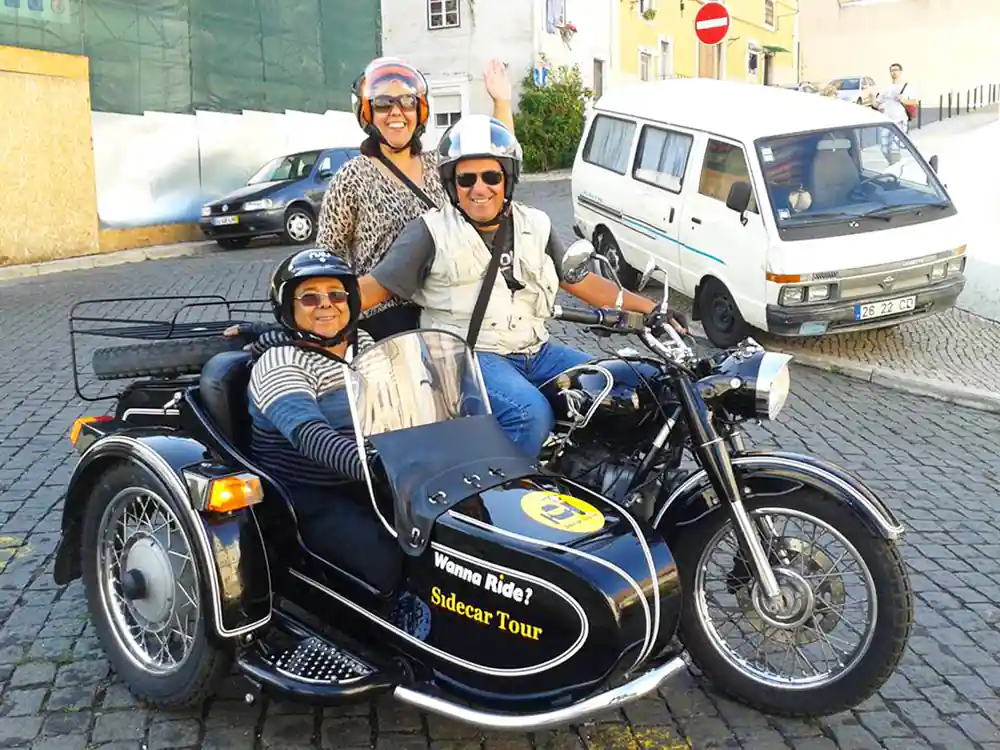
A mid-century outfit, back on the streets it was built for
The two forces that ended it
The first was the affordable car. Once mass production brought a small enclosed saloon within reach of the same household, the comparison became one-sided in a single step. The car has doors, a roof, a heater, and it does not require the driver to learn a specialised skill. Every practical argument for the outfit evaporated at once, and the market went with the car almost immediately.
The second was regulation. Licensing regimes across Europe were rewritten repeatedly in the second half of the century, and the effect in several countries was to separate motorcycle entitlements from car entitlements in ways that made an outfit a more awkward proposition rather than a simpler one. Insurance followed the same logic.
The result was not a slow fade so much as a collapse in one particular market segment. Sidecars stopped being ordinary and became a choice, and a choice made mostly by enthusiasts, specialists, and people whose roads or budgets left them with a reason.
Where it survived
Production continued where the arithmetic still worked. In countries with long winters, difficult roads and constrained supply of cars, the outfit remained a useful vehicle for decades after it had become a curiosity elsewhere, and factories kept building them in numbers. That is the single biggest reason serviceable machines still exist in quantity.
Specialist manufacture also continued at the other end of the market, building chassis for particular motorcycles for a small and knowledgeable clientele. Racing kept its own branch alive entirely, in a form that looks almost nothing like a touring outfit and is worth watching once.
The consequence for a visitor today is straightforward: there is a supply of restorable mid-century machines and a body of people who know how to keep them running. Without both of those, a sidecar tour of a European city would not be a business anybody could operate.
40 years
For roughly four decades the sidecar was ordinary family transport across Europe, before the affordable enclosed car ended the argument in a single step.
Why it came back as an experience
What killed the sidecar as transport is exactly what makes it valuable as an experience. It is open, it is slow, it is conspicuous, and it requires a skilled driver. Those are all defects in a commuter vehicle and all virtues in something you have deliberately chosen to spend an afternoon in.
There is also the matter of scale. A sidecar is small enough for streets laid out before cars existed, which describes the historic centre of most old European cities. The vehicle and the streets are from compatible eras, and it shows in how naturally the machine fits through places a modern car struggles with.
So the outfit ends up doing in the twenty-first century almost the opposite of its original job. It was invented to be the economical practical option and it survives as the impractical memorable one, which is a fair trade for something that was nearly extinct.
What this means for the machine you ride in
A tour outfit is a piece of working history rather than a replica. The chassis design, the geometry, the way the chair is braced against the frame, all of it comes from a period when these things were being refined under real commercial pressure by people who needed them to survive daily use.
That history is also why the machines demand attention. Parts are not on a shelf, tyres are a specialist order, and the person who maintains the vehicle usually turns out to be the person driving it. Operators who take this seriously tend to talk about their machines the way other people talk about pets.
Knowing when the thing was invented and what it was for changes the ride slightly. You are not sitting in a novelty. You are sitting in the ordinary transport of somebody's great-grandparents, going up a hill it was designed to climb.
Ride the machine, not the museum piece behind glass
from US$116Reserve now & pay later